New life for dormant buildings
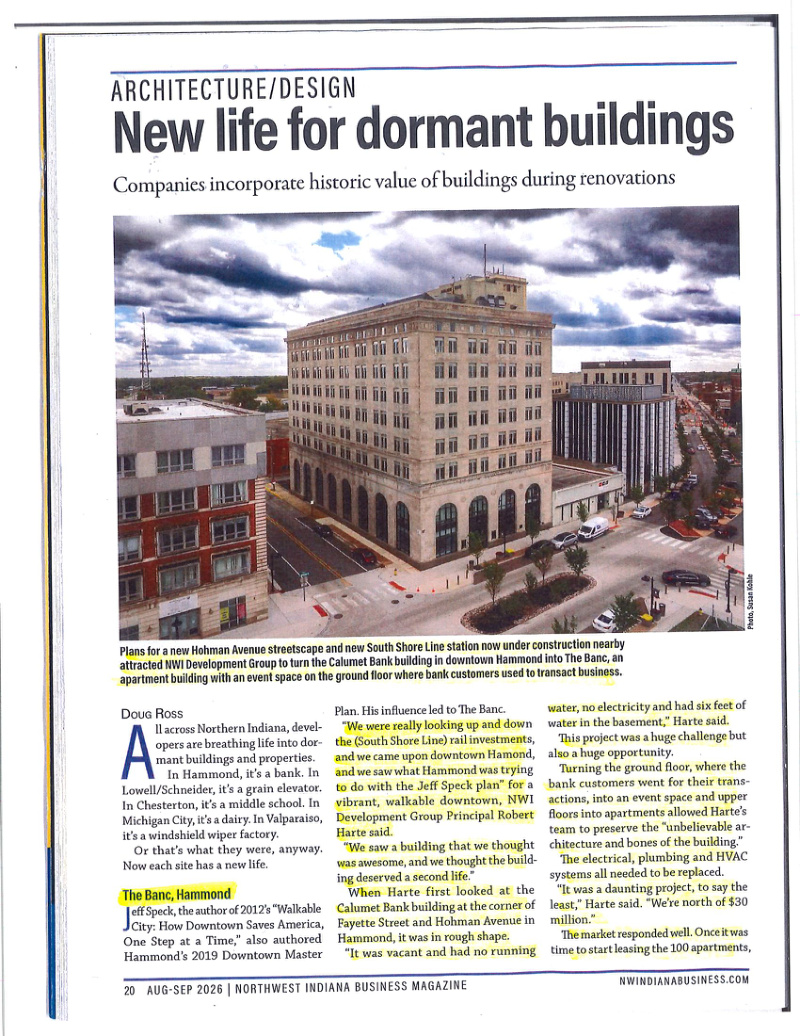
Regional adaptive-reuse reporting, including NWI Development Group’s conversion of Hammond’s Calumet Bank building into The Banc.

17 acres in the shadow of the Indiana Dunes National Park — 88 homesites wrapping a private, natural-water 26-acre lake, completing the 43-acre assemblage, 500 yards from Lake Michigan and its Chicago-skyline horizon.
Current planning basis: October 13, 2026. 88 concept homesites; $11,700,500.26 modeled development uses; 50-month workbook schedule. Land acquisition is entered as zero, not confirmed free. Read the reconciled financial guide or explore the current investor assumptions. Older 71-site, budget, entitlement and return illustrations below are historical, not current investment terms or certification of approvals.
For the first ten thousand years after a retreating glacier left them in its wake, the dunes were threatened only by high winds and waves. Now man has stepped in — towering dunes, a natural fern grotto, beautiful old trees. Indiana Dunes Club is the last major assemblage on this stretch of the Indiana shoreline, and the only property in Michigan City — or across Long Beach and Grand Beach — that offers direct access to both Lake Kai and Lake Michigan.
“These dunes are somewhat unique, and, collectively, probably represent the largest accumulation of sand dunes along any fresh water body in the world. The environmental conditions under which they were formed no longer exist: once destroyed, these dunes are not likely ever to regain their present significant size and extent.”
Cradled by dunes and fed by natural water, the 26.2-acre Lake Kai anchors 42.75 acres of contiguous rights — adjacent to the acclaimed Beachwalk Resort, steps from Lake Michigan, an hour from Chicago, and at the doorstep of Harbor Country.
88 concept homesites around a sponsor-directed 26-acre lake and 17 acres of land, totaling a 43-acre planning program. Final plat approval, individual ownership structure, common-area rights and acquisition terms require confirmation; concept counts are not released inventory.
Seventy-one lots wrapped around Lake Kai frontage, with custom resort homes from 2,000 to 4,500 sq ft. The amenity plan is anchored by an All-Seasons Resort Club with an indoor–outdoor retractable-roof pool, a wellness center, and Lake Kai boathouses.
Directly adjacent to the acclaimed Beachwalk Resort and the highly successful Whisper Dunes — the two neighboring communities that have set the pricing floor for rental and non-rental luxury sales. Indiana Dunes Club draws from the best of both and takes the concept to the next generation.
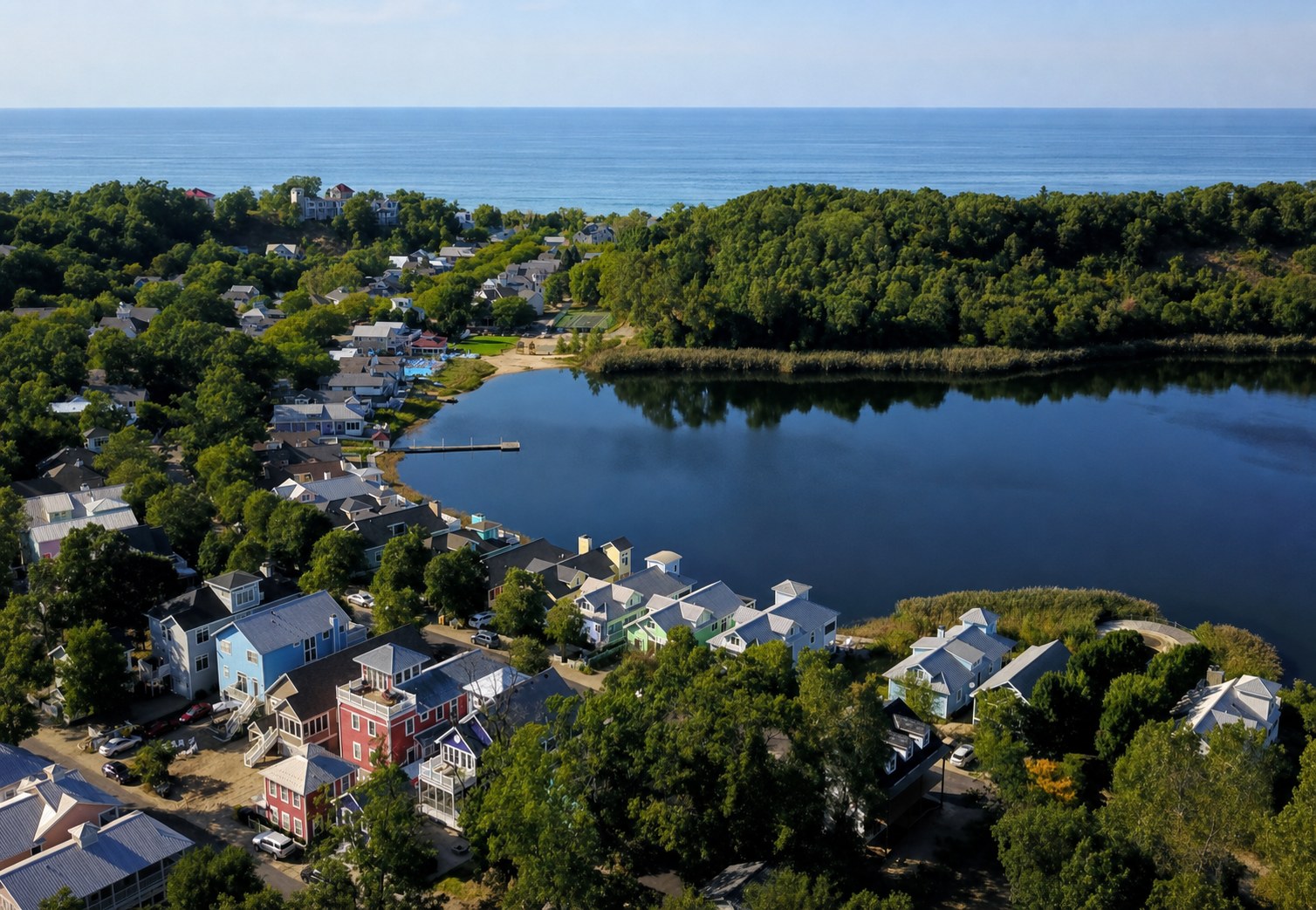
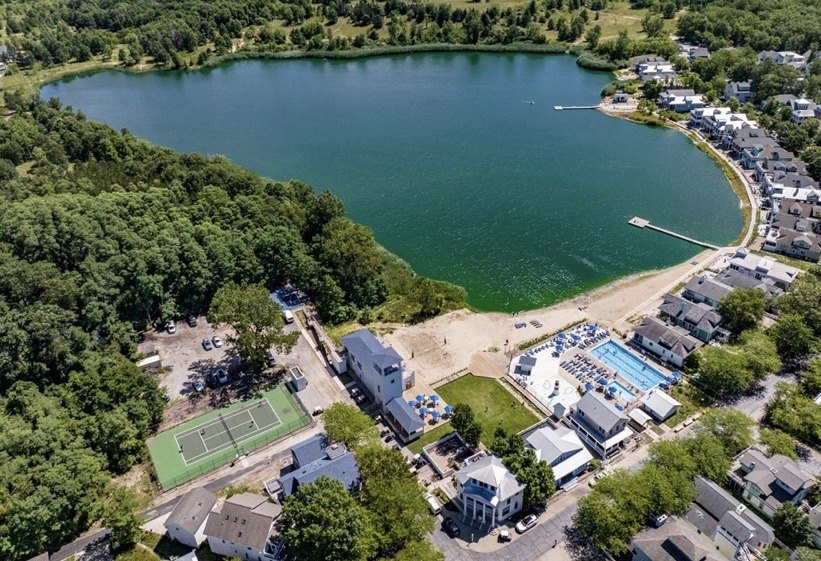
Lake Kai (foreground) wraps the private 26.2-acre lake at the heart of the 42-acre assemblage. Beachwalk Resort's cottages sit up on the dunes; Lake Michigan is beyond.
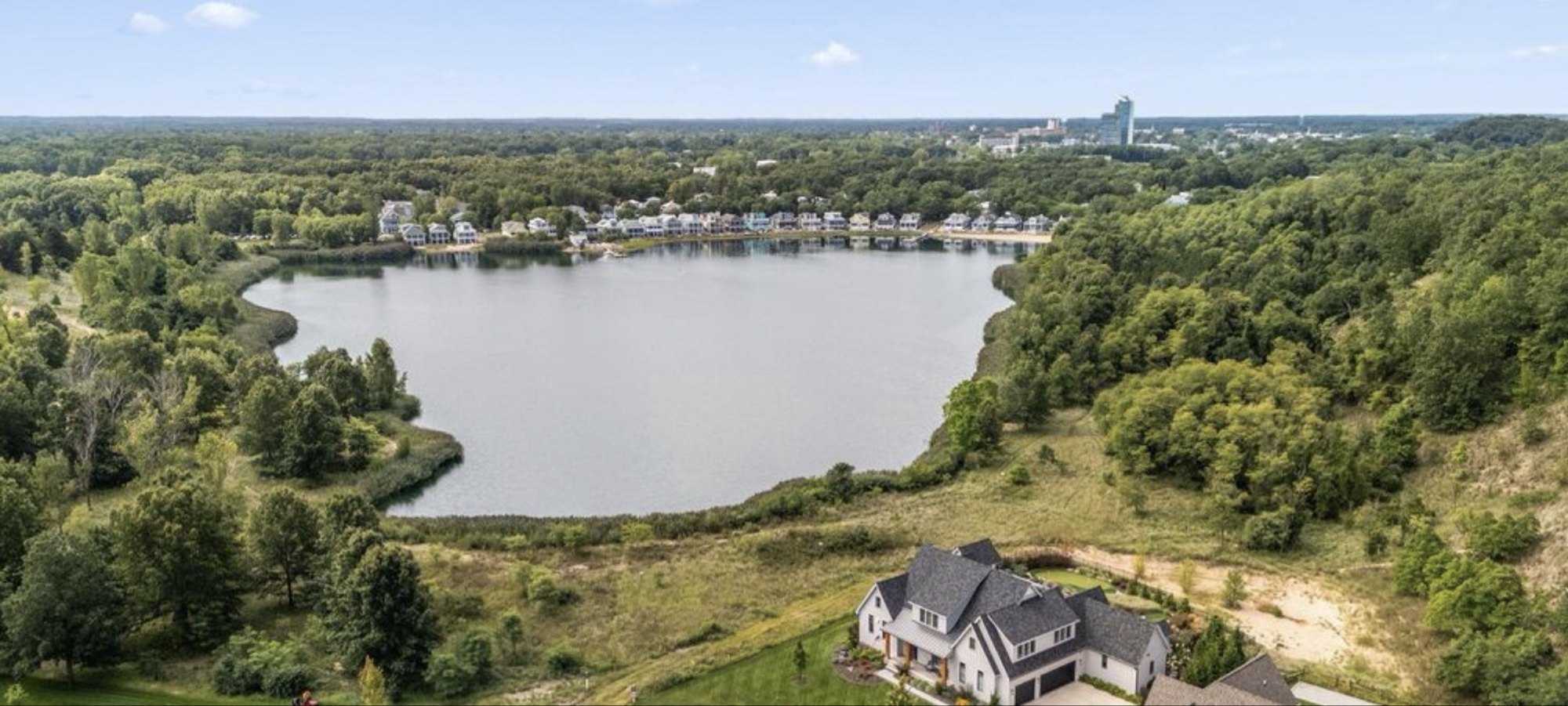
Michigan City sits sixty miles east of the Loop, connected by the South Shore Line's newly double-tracked commuter rail. It has always been Chicago's water access — Al Capone's lakefront estate stood a mile from this site — and it is quietly becoming so again. Indiana Dunes Club sits steps from Lake Michigan, with private access to Lake Kai, in the shadow of the Indiana Dunes National Park, and at the doorstep of Harbor Country.
The Indiana Dunes National Park and its sister Indiana Dunes State Park together welcomed more than 4 million visitors in 2025 — more than Grand Canyon, Yellowstone, or Yosemite, and more than the combined 2026 home attendance of the Chicago Cubs and White Sox. Beachwalk Resort’s 200 homes trade between $675K and $1.4M. Indiana Dunes Club sits on the last privately held shoreline of Lake Kai.

Chicago sits sixty miles across Lake Michigan — visible from the Indiana Dunes Club lake access boardwalk and beach on a clear evening. Indiana Dunes Club owners watch the city skyline light up while their guests pay a resort premium for the same horizon.
Two neighboring communities have already proven these dunes through two very different theses — one a vibrant, family-oriented rental resort in its third decade, the other a quiet 10-home luxury enclave that sold out in five years. All three sit on the same dune ridge along Lake Michigan. Indiana Dunes Club is the next generation: neither a replica nor a compromise, but the premier wellness resort the Indiana Dunes have been building toward.
200 homes, twenty years — a vibrant resort still climbing.
10 homes, no shared amenities — the quiet enclave that sold out anyway.
71 homesites on the last shoreline between them — the resort and the enclave, unified.
Two proofs, one progression. The evidence tables below drill into each community’s pricing and appreciation across the last three to twenty years.
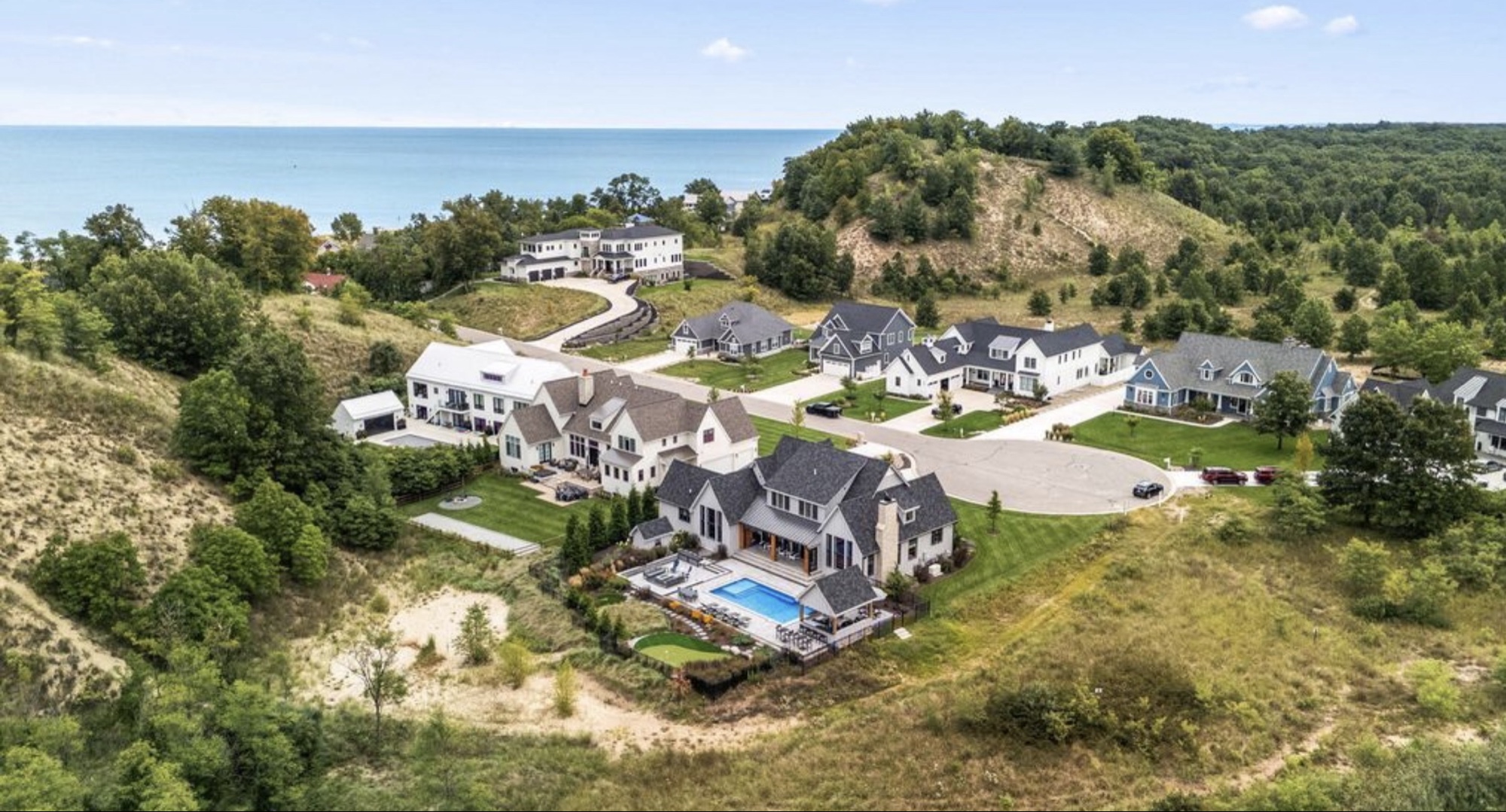
In 2016, a 10-lot parcel off the western edge of this property was released to the Whisper Dunes developer, who platted Whisper Dunes Drive, delivered infrastructure, and built out 10 custom luxury homes between 2017 and 2021 — a highly successful non-rental enclave that sold out and saw homes jump in value on delivery.
Whisper Dunes homes share the same dunes as Indiana Dunes Club and enjoy views of Lake Kai and access to Lake Michigan — but have no Lake Kai frontage, no shared amenity infrastructure, and were built at one-seventh the scale.
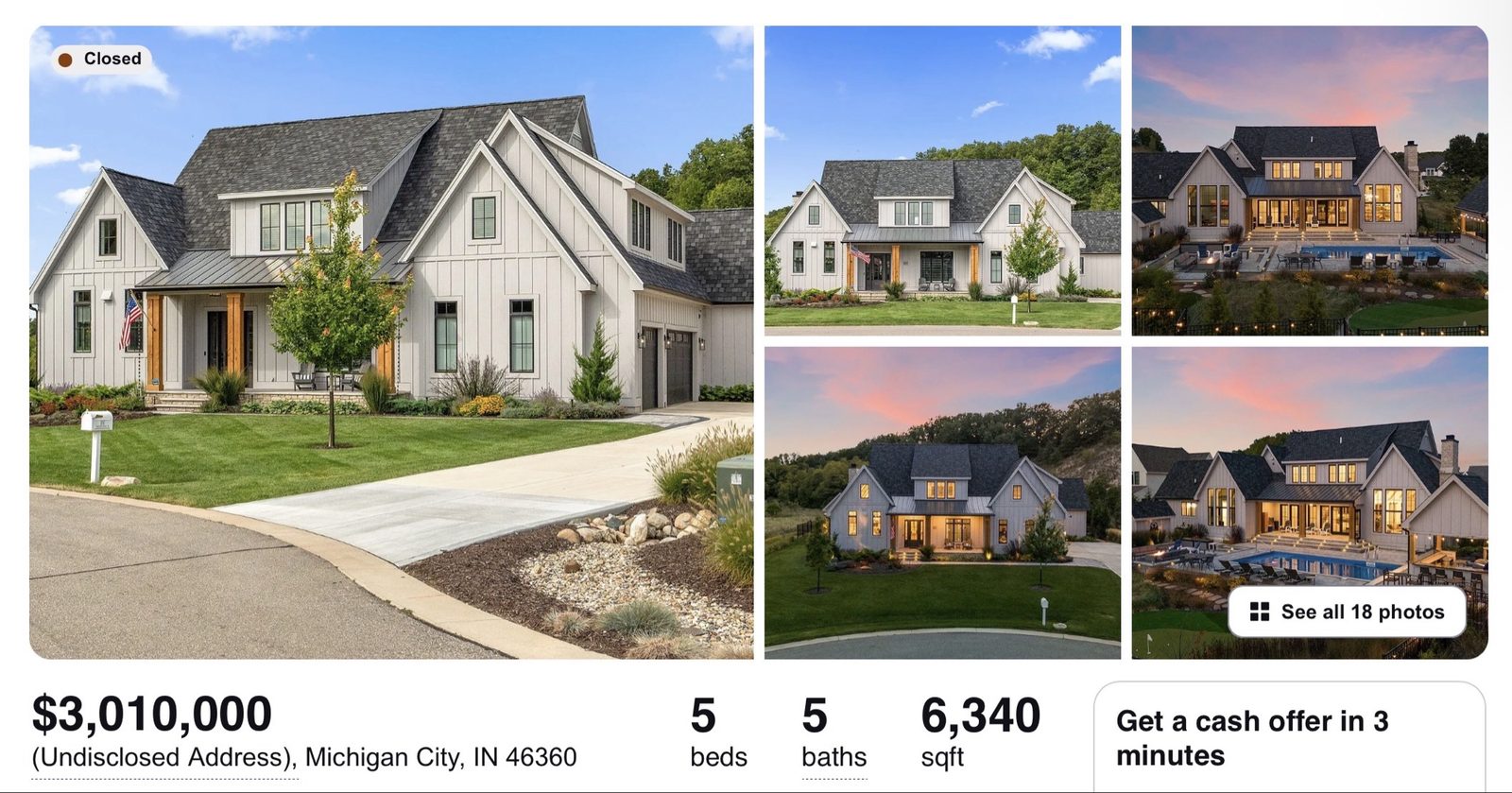
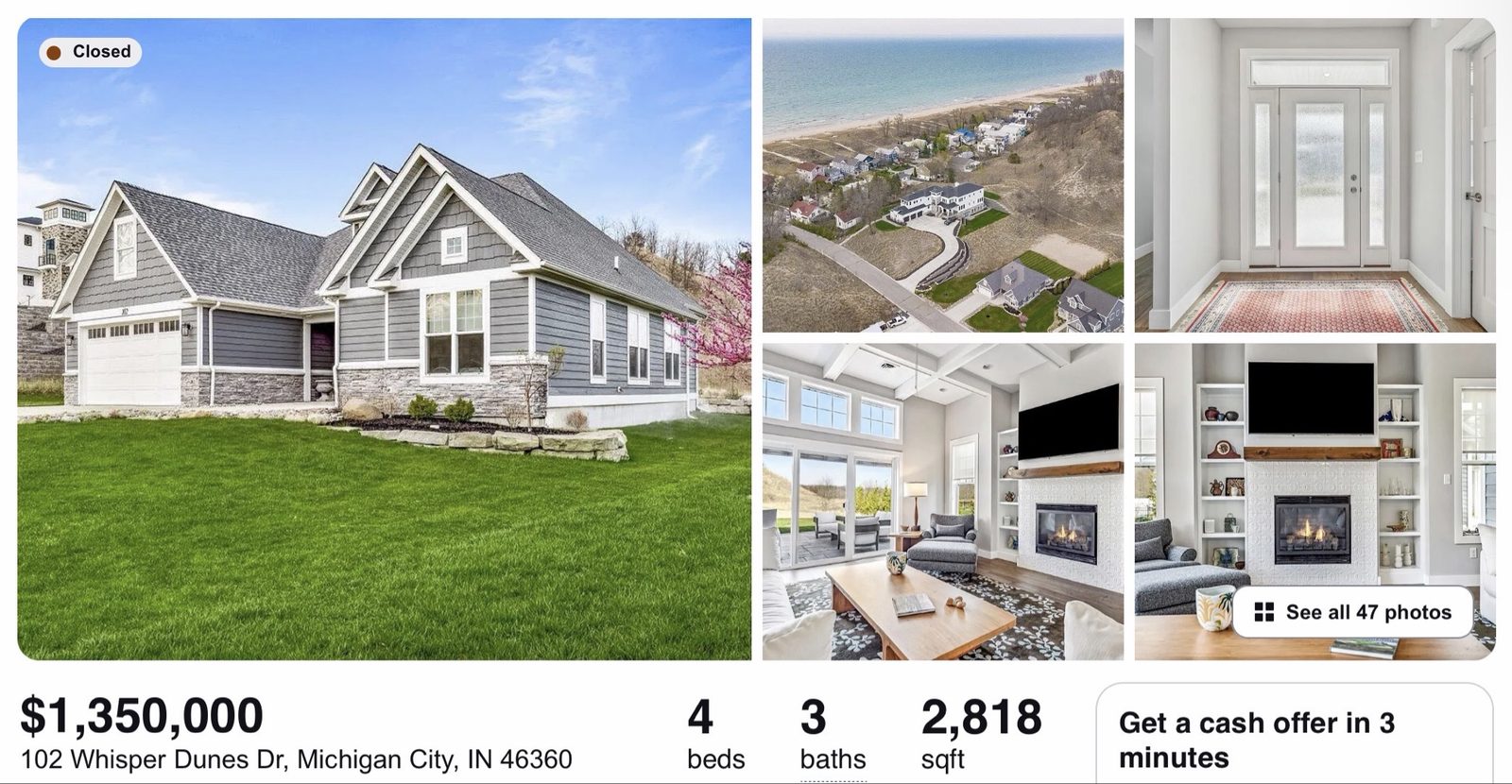
Two confirmed 2025–26 closings anchor the finished range: 102 Whisper Dunes Dr (2,818 sf) traded at $1,350,000 on 10/29/25, and 107 Whisper Dunes Dr (6,340 sf) closed at $3,010,000 on 04/17/26 (@Properties Christie’s). Average property tax is ~$9,100/year, consistent with $1M+ assessed values. Whisper Dunes settles the non-rental luxury demand question; Beachwalk settles the rental one.
Whisper Dunes lots cleared with no Lake Kai frontage at the prices shown below — setting the raw-land floor for these dunes.
| Address | Price per lot | Date |
|---|---|---|
| 5 Whisper Dunes Dr | $399,000 | Listed 2017 |
| 7 Whisper Dunes Dr | $235,000 | Aug 2018 |
| 101 Whisper Dunes Dr (Lot 1) | $285,000 | Nov 2020 |
| 110 Whisper Dunes Dr (Lot 10) | $245,000 | Listed 2020 |
| 101 Whisper Dunes Dr (resold) | $325,000 | Apr 2024 |
All Whisper Dunes lots have views of Lake Kai but no Lake Kai frontage. Indiana Dunes Club homesites carry deeded Lake Kai frontage — a category the comp set does not offer.
Finished pricing benchmark: 102 Whisper Dunes (2,818 sf, 2021 build) at $1.4–$1.48M → ~$495–$525/sf. Applied to the 4,800–7,500 sf estates on the street, implied values reach $2.4M–$3.7M.
| Address | Built | Sq Ft | Lot | Price | Status |
|---|---|---|---|---|---|
| 100 Whisper Dunes Dr | 2019 | 7,538 | 1.94 ac | ~$1.40M (est.) | Off-market |
| 102 Whisper Dunes Dr | 2021 | 2,818 | 0.75 ac | $1,350,000 | Sold 10/29/25 |
| 107 Whisper Dunes Dr | 2022 | 6,340 | 0.87 ac | $3,010,000 | Sold 04/17/26 |
MLS-listed at @Properties Christie’s International Real Estate
Whisper Dunes cleared at $235K–$399K per lot with $475–$525/sf finished construction — and no Lake Kai frontage. Beachwalk’s 200-home rental resort has more than doubled in value over twenty years. Indiana Dunes Club draws from both, on the same dunes, with deeded Lake Kai frontage, an All-Seasons Resort Club, and 71 fee-simple homesites. Beachwalk and Whisper Dunes set the floor — not the ceiling.
Sources: @Properties Christie’s International Real Estate (Kaileyne Krask, Michele Gallas listings), NIRA MLS, Coldwell Banker Homes, Redfin, Trulia, LakeHomes.com, Talk to Tucker (MLS-syndicated public listing data). Confirmed closings: 102 Whisper Dunes Dr — $1,350,000 (10/29/25, 2,818 sf); 107 Whisper Dunes Dr — $3,010,000 (04/17/26, 6,340 sf).
Two hundred homes on the adjacent lake have set the price band and proven the rental pool. Indiana Dunes Club enters an established market — not a speculative one.
| Beachwalk Reference | Low | High | Source |
|---|---|---|---|
| Home resales (recent, 2024–26) | $675K | $1.4M | Realtor · Zillow |
| $/SF at resale | $336 | $459 | Realtor · Zillow |
| Raw lot sales | $226K | $275K | Redfin · RealtyTrac |
| Airbnb occupancy (117 listings) | — | 51% | Airbtics |
| Airbnb ADR | — | $578 | Airbtics |
| Historical booking anchor | 135 nights | $460 ADR | EDCMC 2022 |
| Indiana Dunes NP visitors (2023) | — | 3.1M | NPS Stats |
Sources: EDCMC Residential Market Analysis 2022 · Airbtics · Chalet · AirROI · Zillow · Redfin · Realtor.com · NPS.
Beachwalk’s 200 homes are the acclaimed rental-resort comp next door — an early-2000s buildout, now roughly twenty years old, whose pricing has climbed every year and more than doubled in ROI and value. Every figure below is drawn from MLS-fed price histories and short-term rental data between January 2023 and August 22, 2026. Beachwalk trades at four to five times the ZIP median and has fully decoupled from Michigan City’s broader market.
| Metric | 2023 | 2024 | 2025 | 2026 YTD |
|---|---|---|---|---|
| Median sold price | $730K | $880K | $850K | $1.07M |
| Median $/sqft | $254 | $327 | $397 | $459 |
| List-to-sale ratio | 90–93% | 97.0% | 99.4% | 115.6% |
| Documented closings | 5 | 2 | 3 + 1 lot | 4 |
+46% median price · +81% $/sqft over three years. Buyers now pay ~16% over ask on turnkey product.
Each closed in the last four months. Each redefined what buyers will pay to live on Lake Kai.
Lake Kai waterfront · 4BR/3.5BA · 3,139 sf
2018 build · 4BR/3BA · 2,504 sf
Modern bluff home · 4BR/4BA · 3,300 sf
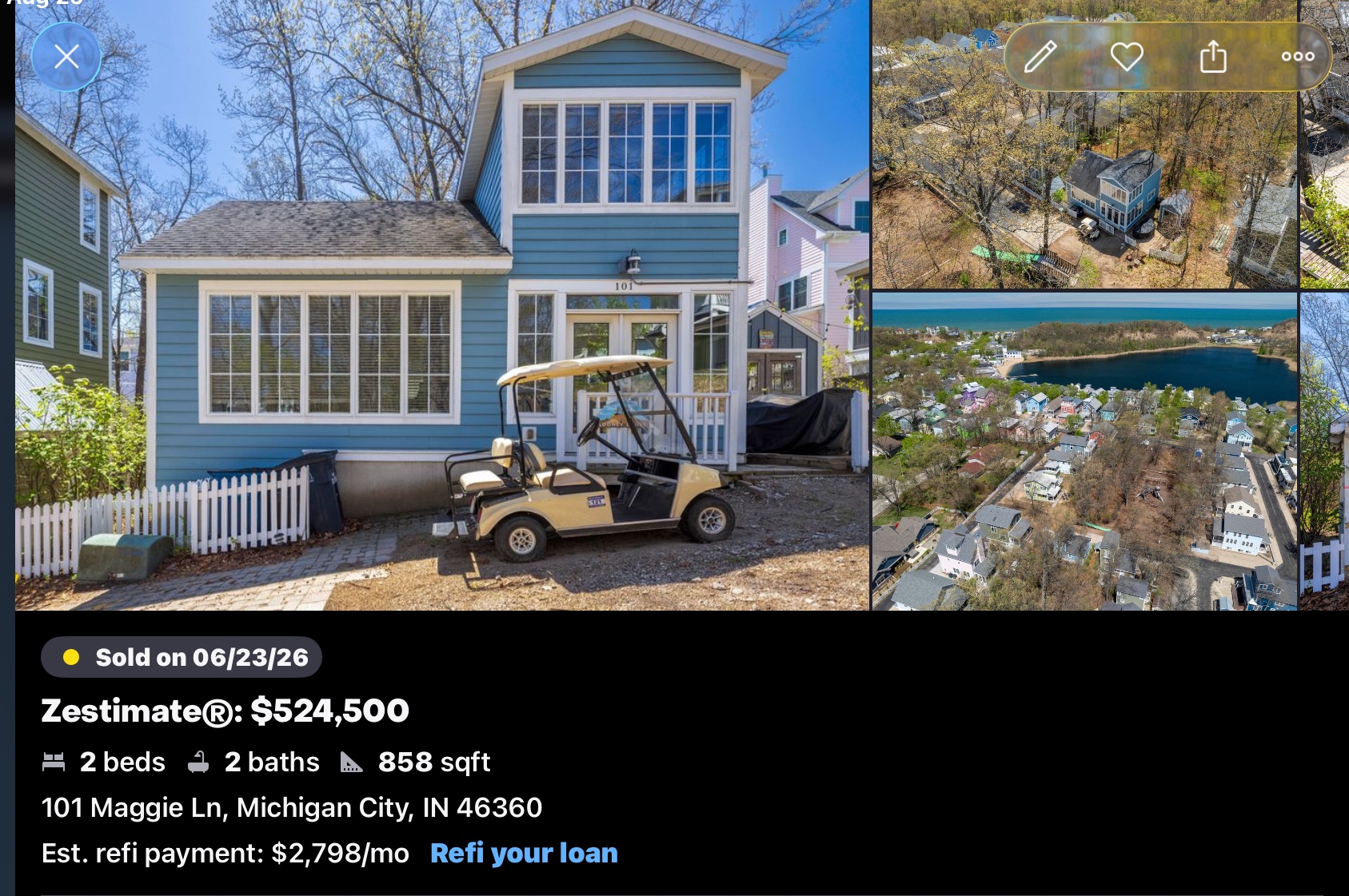
A 2007-built, 858 sq ft two-bedroom cottage in the Cason Park pocket immediately adjacent to Beachwalk. The transfer history is a live read on the neighborhood’s pricing floor over the last decade — and the June 2026 closing at $608/sf shows small-footprint Beachwalk-area cottages now price well above the resort’s larger-home median.
3.48× the 2013 basis · $608/sf on the June 2026 closing (858 sf) · Source: LaPorte County Beacon (Parcel 46-01-21-476-068.000-022, Cason Park Lot 167 B), Zillow.
Recent sold comparables from $850K to $3.3M — the market Indiana Dunes Club sits inside.
Listing photos courtesy of Northern Indiana Regional MLS (NIRA), @properties/Christie's, Coldwell Banker Realty, and Weichert Realtors.
Michigan City STR analytics, Q2 2026 — Beachwalk rental economics by bedroom count.
| Bedrooms | ADR | Occupancy | Est. annual gross |
|---|---|---|---|
| 3 BR | $332 | 50% | $60,590 |
| 4 BR | $559 | 57% | $115,658 |
| 5 BR | $747 | 56% | $153,645 |
Beachwalk proves the rental demand. Whisper Dunes proves the non-rental luxury demand. Indiana Dunes Club delivers the supply — 71 fee-simple homesites on the private 26.2-acre lake next door, at the luxury tier the current comp set is already reaching for.
Sources: Compass · @properties / NWI MLS · Trulia · Redfin · Zillow · homes.com · Coldwell Banker · Realtor.com · AirDNA · AirROI · GuestFavorites · VRBO · Expedia. Full analysis available on request.
Beachwalk built the acclaimed rental base. Whisper Dunes proved the luxury non-rental ceiling. Indiana Dunes Club is neither a replica of Beachwalk nor of Whisper Dunes — it draws the best of both and delivers what a $2M+ buyer expects in 2027: private Lake Kai water rights, an All-Seasons Resort Club with retractable-roof indoor–outdoor pool, a full wellness campus, and a concierge fleet on Lake Michigan itself.
Where Beachwalk platted for density, Indiana Dunes Club plats for privacy. Estate-scale lots with buildable pads sized for 2,000–4,500 sf custom resort homes, buffered by mature dune landscape and native plantings.
Owners receive deeded access to Lake Kai with permitted private docks and architect-designed cantilever boathouses — an amenity Beachwalk homeowners cannot replicate on their side of the water.
A curated architectural review board and a short list of luxury custom builders. Modern lakehouse and refined coastal vernaculars, natural material palettes, indoor–outdoor living calibrated to the dune microclimate.
The Central Commons is programmed as a year-round wellness destination — the reason owners come out on off-weekends and stay longer than they planned.
The Central Commons is anchored by an All-Seasons Resort Club with an indoor–outdoor pool under a retractable roof — usable in every season, from July poolside to January snow-globe views over Lake Kai.
A year-round pool is a category no other Indiana Dunes community offers.
The fleet is berthed at Michigan City Harbor and captained on-demand — anchoring off the Indiana Dunes Club beach so owners can wade or paddle out and step aboard. No trailering, no launching, no waiting in line.
Amenity program is planned; final scope will be finalized during entitlement and phased with vertical delivery. Fleet vessels operated under a shared services agreement with Michigan City Harbor.
The design language of the dunes shoreline — outdoor living, quiet materiality, and the small rituals of a lake day. Indiana Dunes Club builds toward this vocabulary at community scale.
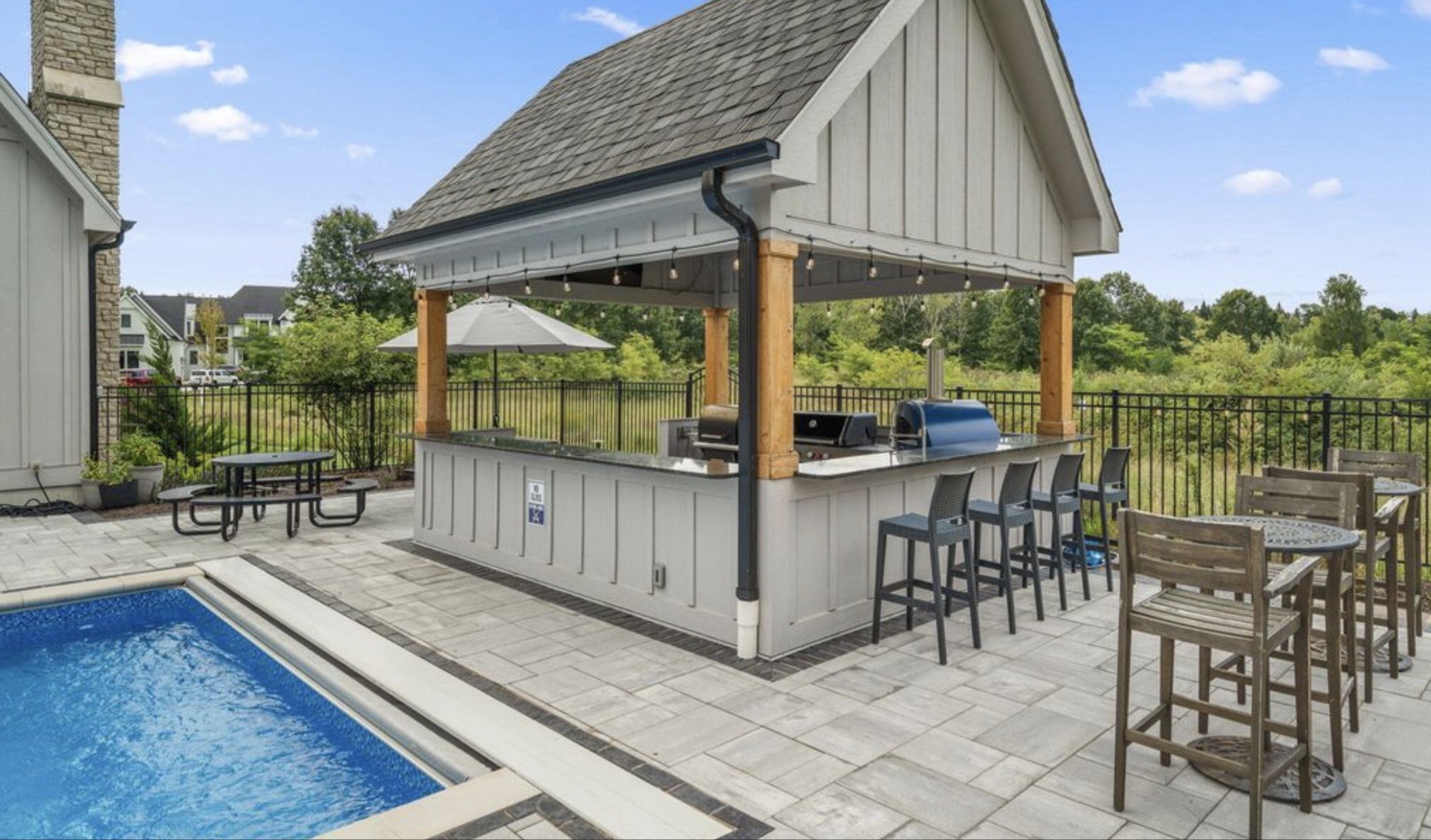
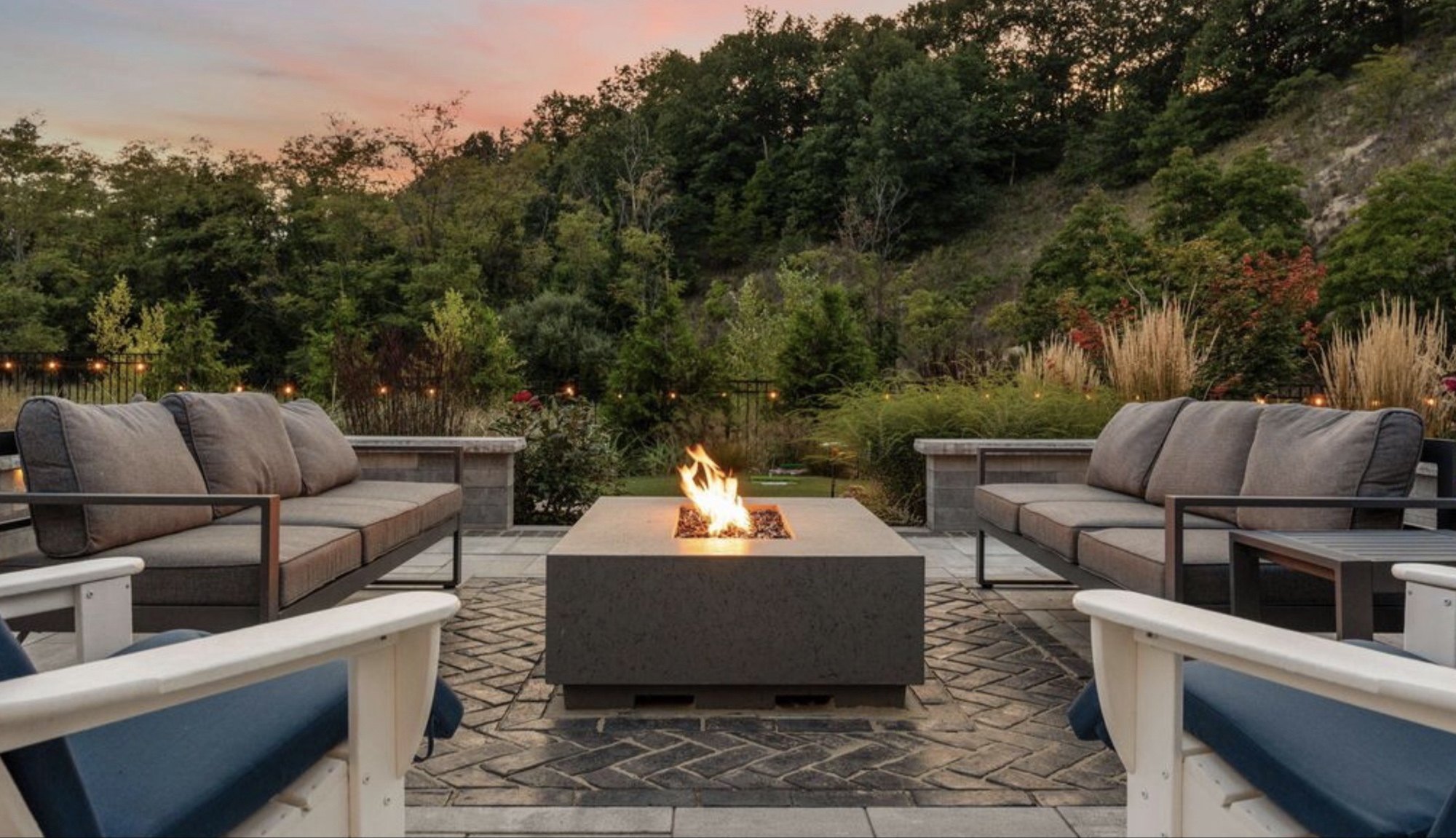
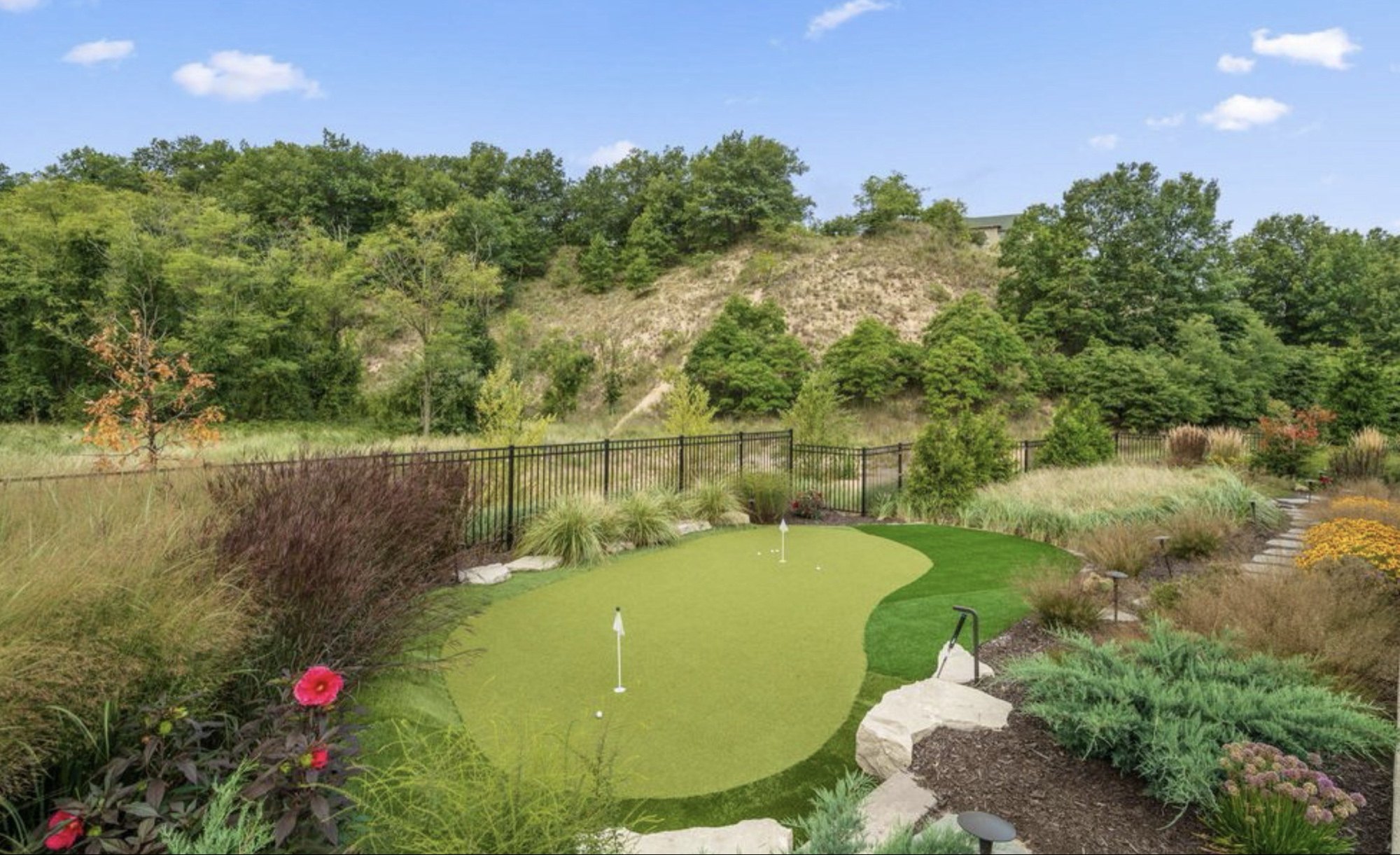
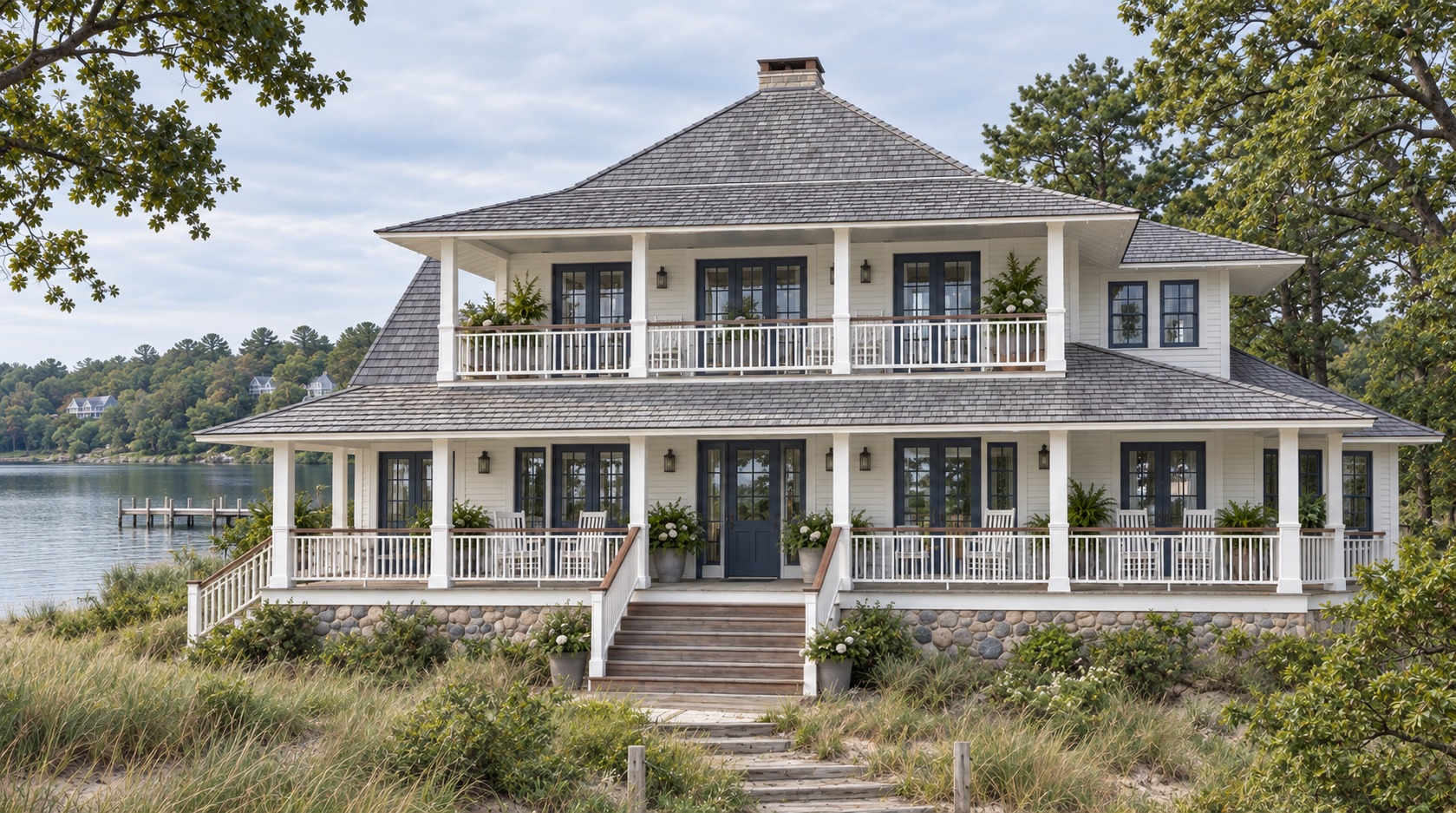
Central Commons will host the clubhouse, pool, and management office. South Commons closes the loop with a common lawn and two pickleball courts. Twelve-foot private drives connect every lot to the water.
Beachwalk validated the shoreline. Indiana Dunes Club is what happens when you build the same setting 25 years later, without the density — larger lots, private lake frontage with docks, and a wellness-first amenity program purpose-built for the buyer who already owns everywhere else.
Historical illustration, not current underwriting. The following legacy figures and terms are not the corrected 88-unit base case. Use the October 13 financial guide and corrected workbook for current assumptions. Entitlements, offering terms and tax eligibility require independent confirmation.
The seventy-one-lot yield plan is entitled by-right in the underlying zoning district — execution requires a standard subdivision plat approval from the Michigan City Plan Commission under the City’s subdivision control ordinance. The property lies within the incorporated City of Michigan City, not unincorporated LaPorte County — the City holds sole planning and zoning authority. Each finished lot will convey fee simple, the most complete and absolute form of land ownership. A PUD overlay would permit greater density, but the sponsor’s plan is to execute the as-of-right seventy-one-lot subdivision without seeking a PUD.
Contiguous title held under a single ownership entity. Rights include the Lake Kai water body and the surrounding developable ground.
Seventy-one lots is the yield plan under existing by-right zoning. Executes via a standard Michigan City Plan Commission subdivision approval — no rezone, no PUD, no variance required.
A PUD overlay would allow higher density on the site. The sponsor has elected to execute the as-of-right seventy-one-lot plan rather than pursue additional density through a PUD.
Eight legal parcels totaling 42.75 acres of contiguous rights, held under a single JV entity. The 32.708-acre main tract wraps Lake Kai; adjacent Tecumseh Street and Prospect Road parcels complete the assemblage.
Each lot meets the underlying district minimums with a standard 100 × 50 footprint. Yield plan sized for the seventy-one-lot subdivision without variance.
Ordinance requires 25% of the 16.55-acre developable area as common open space. The yield plan provides 25.7% — slightly over standard, absorbing the Central and South Commons amenity footprint.
Water, sewer, electric, and gas are confirmed in place to the site by the City of Michigan City. No off-site trunk extensions required to bring service into the subdivision.
Historical illustration, not current underwriting. The following legacy figures and terms are not the corrected 88-unit base case. Use the October 13 financial guide and corrected workbook for current assumptions. Entitlements, offering terms and tax eligibility require independent confirmation.
Indiana Dunes Club enters a joint venture at land takedown — $6M equity, clean OZ entry. From there, four exit paths, each modeled to the dollar in the interactive tool.
Entitle, install horizontal, sell up to 71 lots to end buyers and small builders. Lightest touch, fastest capital return.
Vertical construction. Homes at $300/SF build → $750/SF sell. Townhomes at $225/SF build → $500/SF sell.
Beachwalk Vacation Rentals model. 45% of homes into rental pool. ~135 booked nights at $460 ADR (EDCMC anchor).
Verified inside a designated Qualified Opportunity Zone (LaPorte County Census Tract 430 · GEOID 18091043000) per Treasury / CDFI Fund under IRS Notice 2018-48. Ten-year hold delivers deferred gain + tax-free appreciation. Timing to OZ 2.0 is critical.
Appreciation range defended: Low — 4.8%/yr, LaPorte County long-run projection through 2030 (TowerKing 2026 Market Study). Base — 10.0%/yr, Michigan City 5-yr trailing (2020Q4–2025Q4, +61.2% cumulative, NeighborhoodScout). High — 12.3%/yr, ZIP 46360 median annual appreciation (Indiana Realtors 2025).
All numbers above are base-case anchors. The model lets you drag any assumption and see the four scenarios rebuild live.
Historical illustration, not current underwriting. The following legacy figures and terms are not the corrected 88-unit base case. Use the October 13 financial guide and corrected workbook for current assumptions. Entitlements, offering terms and tax eligibility require independent confirmation.
Full sellout math for the 8-townhome + 63-estate program, benchmarked against Beachwalk's proven 2026 pricing. Every line item is a working assumption based on current Northwest Indiana construction pricing and the Teska Associates site plan.
Vertical construction cost by product type, inclusive of 22% soft costs.
| Product | Units | Sqft | Build $/sf | Hard cost | Soft (22%) | All-in each |
|---|---|---|---|---|---|---|
| Townhomes | 8 | 2,200 | $210 | $462,000 | $101,640 | $563,640 |
| Estates — 4,000 sf | 63 | 4,000 | $260 | $1,040,000 | $228,800 | $1,268,800 |
| Estates — 4,500 sf | 63 | 4,500 | $260 | $1,170,000 | $257,400 | $1,427,400 |
Soft costs (22%) cover architecture & engineering, permits & impact fees, construction-loan interest carry, builder's risk & GL insurance, marketing & broker commission reserve, warranty reserve, and 5% contingency.
The 16.55 acres of developable land already has water, sewer, electric, and gas brought to site by Michigan City. On-site distribution, roadway, and stormwater are the developer's cost. The line items below show a full-scope estimate; the $4M target reflects value-engineered scope for the base case.
| Line item | Low | Working | High |
|---|---|---|---|
| Site clearing, mass grading, erosion control | $350,000 | $425,000 | $500,000 |
| Roads & 12' private access drives (per Teska plan) | $850,000 | $1,050,000 | $1,300,000 |
| Water & sewer distribution (on-site laterals from stubs) | $500,000 | $625,000 | $780,000 |
| Electric & gas distribution, underground | $275,000 | $350,000 | $450,000 |
| Stormwater detention, drainage, outfalls | $400,000 | $500,000 | $650,000 |
| Lake Kai shoreline stabilization & access | $225,000 | $300,000 | $400,000 |
| Entry monumentation, gates, wayfinding | $180,000 | $250,000 | $350,000 |
| Streetscape, sidewalks, tree planting | $225,000 | $300,000 | $400,000 |
| Civil engineering, permits, Michigan City plat, testing | $180,000 | $250,000 | $320,000 |
| Subtotal | $3,185,000 | $4,050,000 | $5,150,000 |
| Per-lot allocation (71 lots) | $44,859 | $57,042 | $72,535 |
Central Commons (clubhouse, pool, management office) and South Commons (common lawn, pickleball, dock/beach). Amenity spend is what separates a subdivision from a resort community and directly supports the pricing premium. Line items show a full-scope program; the $2M target funds Phase 1 (clubhouse, pool, one pickleball court, beach access) with balance released against sellout milestones.
| Line item | Low | Working | High |
|---|---|---|---|
| Clubhouse (~3,500 sf: lounge, kitchen, restrooms, mgmt office) | $975,000 | $1,225,000 | $1,500,000 |
| Pool, pool deck, cabanas, equipment room | $425,000 | $575,000 | $775,000 |
| Pickleball courts (2), lighting, fencing | $135,000 | $185,000 | $260,000 |
| Fire terrace, gathering areas, hardscape | $120,000 | $165,000 | $225,000 |
| Private beach access + dune stairs / boardwalk | $140,000 | $185,000 | $260,000 |
| Lake Kai dock, kayak launch, community boathouse | $225,000 | $325,000 | $475,000 |
| South Commons landscaping, common lawn, putting green | $180,000 | $250,000 | $340,000 |
| Amenity FF&E, signage, technology | $140,000 | $195,000 | $275,000 |
| Design fees, permits, general conditions | $540,000 | $745,000 | $990,000 |
| Subtotal | $2,880,000 | $3,850,000 | $5,100,000 |
| Per-lot allocation (71 lots) | $40,563 | $54,225 | $71,831 |
Amenity build phased: clubhouse + pool + one pickleball court in Phase 1 (~$2.2M), remainder released with lot 40 sales trigger. HOA transfer at 65% sellout.
Entitlements plus infrastructure plus amenities — the horizontal spend before any home is built.
Estate assumption: 4,500 sf. Highlighted row is the recommended blended target.
| Sale $/sf | Townhome sale | TH margin | Estate sale | Estate margin |
|---|---|---|---|---|
| $450/sf | $990,000 | 43.1% | $2,025,000 | 29.5% |
| $500/sf | $1,100,000 | 48.8% | $2,250,000 | 36.6% |
| $550/sf | $1,210,000 | 53.4% | $2,475,000 | 42.3% |
| $600/sf | $1,320,000 | 57.3% | $2,700,000 | 47.1% |
Estates at 4,500 sf. Target entitlements ($1M) + infrastructure ($4M) + amenities ($2M) = $7M horizontal. Land basis excluded — add your actual acquisition/carrying cost.
| Blended $/sf | Gross revenue | Vertical build | Site dev | Total costs | Net profit | Margin |
|---|---|---|---|---|---|---|
| $450/sf | $135.5M | $94.0M | $7.0M | $101.0M | $34.5M | 25.5% |
| $500/sf | $150.6M | $94.0M | $7.0M | $101.0M | $49.6M | 32.9% |
| $550/sf | $165.6M | $94.0M | $7.0M | $101.0M | $64.6M | 39.0% |
| $600/sf | $180.7M | $94.0M | $7.0M | $101.0M | $79.7M | 44.1% |
The blended $/sf required to hit each margin, benchmarked against real Beachwalk closings.
| Threshold | Required blended $/sf | Beachwalk benchmark |
|---|---|---|
| Full breakeven | $336/sf | Below Beachwalk 2023 median — impossible to lose money on vertical alone |
| 15% margin | $396/sf | Beachwalk 2025 median ($397/sf) |
| 25% margin | $449/sf | Below Beachwalk 2026 YTD ($459/sf) |
| 30% margin | $481/sf | +5% premium to Beachwalk 2026 |
| 35% margin | $519/sf | +13% premium to Beachwalk 2026 |
| 40% margin | $563/sf | +23% premium — justified for lakefront + new construction |
Target budget of $1M entitlements + $4M infrastructure + $2M amenities = $7M horizontal, or ~$98.6K/lot. At a $550/sf blended sellout, the project nets ~$64.6M pre-land on a 39.0% margin. Every $500K of site-development overrun costs ~30 bps of margin; every $25/sf of blended pricing lift adds ~$7.5M to net.
Historical illustration, not current underwriting. The following legacy figures and terms are not the corrected 88-unit base case. Use the October 13 financial guide and corrected workbook for current assumptions. Entitlements, offering terms and tax eligibility require independent confirmation.
Indiana Dunes Club accommodates two distinct investor profiles — Illinois OZ investors with $6M+ realized capital gains, and a single family office / long-hold equity partner taking down the land and horizontal infrastructure. Full offering package under NDA.
Roll a $1M+ capital gain into a rural QROF. Ten-year hold. Deferred gain → 30% rural step-up at Year 5 → 100% federally excluded appreciation at Year 10. Each investor funds an individual QROF that acquires a lot and a finished home under a 10-year Wanderluxe NNN master lease.
Fund the $13M all-in land + entitlements + horizontal infrastructure position. 71 fee-simple lots sold to retail buyers, self-directed IRAs, and OZ investors at $300K net Y1 with 6% annual escalators. HOA licensing fee ($100/mo/lot, 3% escalator) retained by investor. Wanderluxe NNN master lease sits behind each home buyer — isolated from land/infra economics.
Targets, not guarantees. Both paths accommodate the same underlying asset — the 42-acre Lake Kai assemblage with 71 entitled fee-simple homesites. Full offering documents delivered under NDA. Request access below →
Historical illustration, not current underwriting. The following legacy figures and terms are not the corrected 88-unit base case. Use the October 13 financial guide and corrected workbook for current assumptions. Entitlements, offering terms and tax eligibility require independent confirmation.
Both offerings sit on the same 42-acre Lake Kai assemblage with 71 fee-simple lots. Neither path carries a promote or a waterfall — investor economics flow directly from the underlying real estate.
Each investor funds an individual rural QROF that acquires a lot and a finished home under Wanderluxe's 10-year triple-net master lease. 30% Year-5 rural basis step-up under OBBBA. No promote, no waterfall — investor owns 100% of the QOF and the underlying asset.
Land + entitlements + horizontal infrastructure funded in full by a single family-office equity partner. 71 fee-simple lots sold to retail buyers, self-directed IRAs, and OZ investors — no bulk-buyer risk. Wanderluxe NNN master lease is separate and sits behind each home buyer.
Neither path uses a promote or a waterfall. The Illinois deck models 71 individually funded QROFs against a per-investor tax outcome; the Solo deck models a single owner taking down the land and horizontal infrastructure with lot sellout and HOA recurring income. Full offering package, financial model, and legal documentation delivered under NDA.
Targets, not guarantees. Offering legal documentation prepared with Cozen O'Connor; OZ tax and accounting structure developed with Baker Tilly. Explore adjustable assumptions in the one-home Illinois OZ Investor model or the 88-home Solo Investor model. Model results are planning illustrations, not tax or investment advice.
Michigan City is the best-positioned Opportunity Zone site in the country. We've studied the others. There is no other OZ like it.
The 2017 Opportunity Zone program designated roughly 8,760 census tracts nationwide, and the permanent OZ 2.0 program under the One Big Beautiful Bill Act will redesignate tracts on a rolling ten-year cycle starting January 2027. Across every one of those tracts, the pattern is nearly identical: distressed urban neighborhoods, rural counties, rust-belt town centers. Almost none combine the three assets that determine long-term real-estate value: a great body of water, a national park, and rail proximity to a top-five American metropolitan economy.
Michigan City has all three, stacked inside a single OZ tract. It sits directly on the eastern shore of Lake Michigan — the fifth-largest freshwater lake in the world by surface area. It is the closest full-service town to the Indiana Dunes National Park, one of the most-visited units in the National Park Service. And the South Shore Line, after its 2024 double-tracking, puts a working-age professional in the Chicago Loop in 62 minutes.
This is the combination that Midwest driveable second-home markets like Harbor Country's Michigan shore, Lake Geneva, Galena, and Door County are built on — the resort places every Chicagoan already drives to. Michigan City is the only OZ in the country that sits inside that same geographic archetype, and it does so at land basis that reflects its industrial past, not its recreational future.
Among 8,760 designated tracts, only one combines a great lake, a national park, and 62-minute rail access to a top-five American metro — delivered at pre-transformation basis under the permanent OZ 2.0 program.
42 acres wrapping the last privately held Lake Kai shoreline, adjacent to a proven rental resort and a proven luxury enclave, in the shadow of the Indiana Dunes National Park — the highest-quality parcel inside the highest-quality OZ in the country.
This is a perfect storm. The federal tax program that rewards long-hold equity lands in the one census tract that combines lake, park, and metro access. The permanent OZ 2.0 restart in January 2027 aligns exactly with the power plant's decommissioning, the rail upgrade already completed, the park's post-designation visitation ramp, and fifteen years of environmental cleanup finally finishing.
Ten years from now, you will not recognize Michigan City. Investors who show up now do so at pre-transformation basis, with the federal tax code paying them to be patient.
This is the thesis. The sections that follow — the timing case, the OZ mechanics, and the worked example — are the evidence.
Historical illustration, not current underwriting. The following legacy figures and terms are not the corrected 88-unit base case. Use the October 13 financial guide and corrected workbook for current assumptions. Entitlements, offering terms and tax eligibility require independent confirmation.
Michigan City did not simply sit through the last five decades of state and federal transformation — it partnered, embraced, and facilitated it. Working alongside the U.S. EPA, the State of Indiana, NIPSCO, NICTD, and the Northwest Indiana Regional Development Authority, the city helped design and execute the methodical retirement of its Rust Belt-era liabilities. That partnership continues today: Governor Braun's “speed of business, not government” doctrine has put Indiana at the top of the Midwest for new investment, and the federal OZ 2.0 restart aligns the tax code with the same clock the city has been running for fifty years. This is what a coordinated shoreline transformation looks like on the way up, and the market has not yet fully re-rated it.
This did not happen overnight, and it did not happen to Michigan City — it happened with Michigan City. Over the last fifty years, federal and state governments have methodically rolled out the Clean Air Act, the Clean Water Act, CERCLA, coal-plant emission rules, and the environmental consensus that followed. Michigan City partnered on the enforcement, facilitated the site-by-site remediation, and helped negotiate the retirement schedule for the Rust Belt-era assets that once capped its ceiling. Fifteen years of environmental cleanup, a scheduled power-plant decommissioning, and a national-park designation on the same shoreline are the visible endpoints of a fifty-year regulatory arc the city helped execute — not one it merely absorbed.
NIPSCO's Michigan City Generating Station — a fixture on the shoreline since 1931 — is scheduled for decommissioning by December 31, 2028 under the utility's integrated resource plan. Decommissioning ends ninety-five years of stack emissions and heat-plume discharge into Lake Michigan a couple of miles from Indiana Dunes Club, and opens a lakefront-facing industrial parcel that had capped the shoreline for a century. Air quality, shoreline aesthetics, and long-term property value reset in the same year. This is the kind of once-in-a-generation municipal transformation that ordinarily prices in years ahead. Here, it hasn't.
The $649 million double-track project reached completion in May 2024, cutting the express Michigan City-to-Chicago Loop run to 62 minutes and adding fourteen weekday trains. Michigan City's new station is the northern anchor of what is now a genuine commuter rail line, not a scenic railroad. The Loop is closer to Indiana Dunes Club than it is to many North Shore suburbs by clock time.
Of all 63 U.S. National Parks, only one carries a state's name in the title: Indiana Dunes National Park, redesignated by Congress in February 2019. Every mention of the park — in a magazine feature, a school textbook, a travel itinerary, a National Geographic special — is unpaid advertising for the state. A slow, permanent brand campaign delivering an intangible dividend to Indiana that no other state receives.
The measurable impact has already arrived. Visitation climbed from 1.76M in 2018 to 2.71M in 2024 — +54% in six years, ranking the park in the top 10% of NPS units. Roughly 60% of visitors come from outside Indiana, generating $25.6M in state and local tax revenue in Porter County alone.
That is the ambient tailwind under every home Beachwalk has sold since 2019, every closing Whisper Dunes has posted, and every homesite Indiana Dunes Club will deliver. The Rust Belt corridor became a shoreline destination — and the park's name kept the state on the front of the postcard.
Michigan City has spent five decades partnering with the U.S. EPA, the State of Indiana, and the Michigan City Sanitary District to methodically dismantle the environmental legacy of its industrial century. The city facilitated legacy-site cleanups, executed Lake Michigan shoreline restoration in coordination with state and federal agencies, and made the Sanitary District infrastructure investment that transformed water quality. Trail Creek and the harbor are actively fished; the beaches are certified clean; the lake itself is clear water. The city didn't wait for the cleanup — it helped design it.
Indiana is consistently rated among the best-managed states in the country — low taxes, low regulation, and an aggressive corporate recruitment posture. The Chicago Bears' June 2025 vote to advance stadium development at Wolf Lake in Hammond is the loudest signal yet: even the anchor tenants of Chicago's civic identity are looking east across the state line. Northwest Indiana is having its moment.
The five tailwinds above would justify a market re-rating on their own. What makes the moment investable rather than merely observable is the sixth factor: Indiana Dunes Club sits inside a federally designated Opportunity Zone under the permanent OZ 2.0 program. The tax code defers, forgives, and ultimately exempts capital gains rolled into this project on the exact ten-year clock the re-rating is arriving on. Every other lakefront recreational market on the Great Lakes lacks this. Michigan City has it.
Any one of these six — the plant decommissioning, the rail upgrade, the national park, the environmental cleanup, the state's business climate, or the OZ designation — would be a meaningful tailwind on its own. Together, on this timeline, they are the setup for a market that has not yet finished re-pricing.
Indiana Dunes Club's ten-year OZ hold aligns with the years the re-rating happens. Investors who show up now do so on the front side of the curve.
Michigan City did not wait for OZ 2.0 to attract capital — it went out and built the conditions that attracted it. Its Economic Development Corporation prospectus documents more than a billion dollars of public and private investment the city has actively facilitated in its three OZ census tracts since 2012 — through zoning reform, TIF financing, incentive programming, and public-private partnership. Indiana Dunes Club is the next anchor on that same tract, and it arrives at the moment the ten-year OZ 2.0 clock resets on work the city has already been executing for a decade.
Michigan City figure is EDCMC's reported cumulative public and private capital investment in the three OZ tracts since 2012 and is not limited to OZ-fund equity. Indiana Dunes Club figure is disclosed direct project cost. National figure is qualified OZ investment as reported by the U.S. Treasury Office of Tax Analysis (Working Paper 128, July 2026).
Named projects reported by Michigan City's Economic Development Corporation, plus documented regional public investment that touches the same three OZ tracts. Every figure below is sourced.
| Project | Category | Investment | Source |
|---|---|---|---|
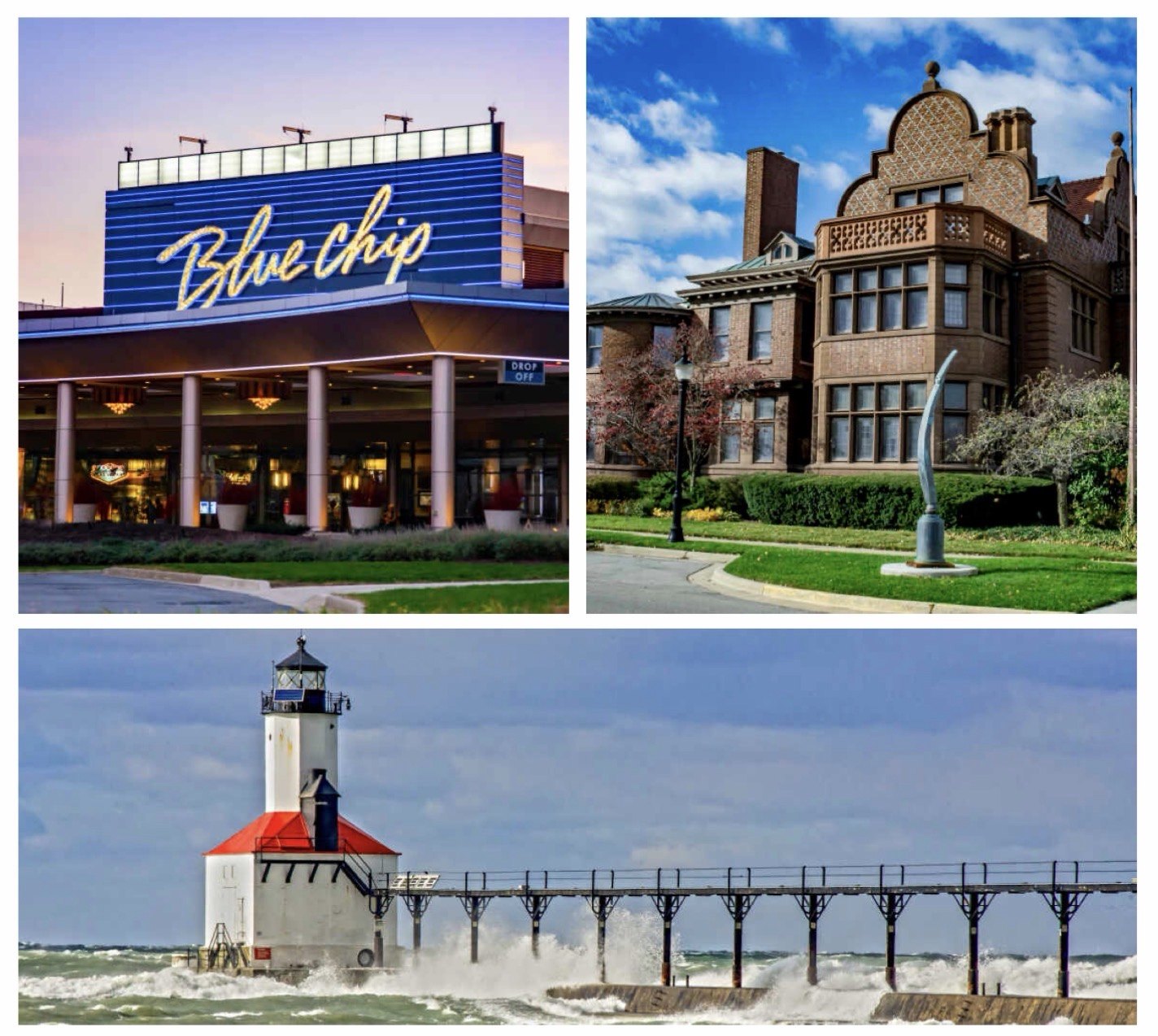
| Blue Chip Casino Hotel & Spa | Hospitality | $243M | EDCMC prospectus |
| Boulevard revitalization | Public infrastructure | $59M | EDCMC prospectus |
| Franciscan Health | Healthcare | $13M | EDCMC prospectus |
| Artspace Lofts | Mixed-use housing | $13M | EDCMC prospectus |
| MCAS solar energy projects | Public utility | $10M | EDCMC prospectus |
| City infrastructure | Public infrastructure | $9M | EDCMC prospectus |
| South Shore Line — Double Track project | Regional rail (Michigan City terminus) | $649M | FHWA project profile |
| Named projects, sourced | $996M | Line-item sum | |
| Plus additional documented public + private investment since 2012 | $1B+ | EDCMC aggregate | |
Line-item projects are as reported in EDCMC's Michigan City Opportunity Zone Prospectus (March 2025). The South Shore Line Double Track project is a regional NICTD/RDA capital project terminating at Michigan City's 11th Street station, funded independently of the EDCMC prospectus totals and reported separately by the Northern Indiana Commuter Transportation District and the Indiana Governor's office in April 2026. The $1B+ aggregate remains as reported by EDCMC.
Michigan City's OZ 2.0 clock does not start at zero. The last billion arrived without a permanent tax code behind it. The next wave arrives with one — codified, permanent, and timed to a market re-rating already underway on the ground.
The U.S. Treasury Office of Tax Analysis reports OZ 1.0 delivered $112 billion into approximately 6,000 designated tracts through 2024, averaging $23.3M per urban tract. Michigan City has three OZ 2.0-designated tracts. The base-rate math points to roughly $210M of new OZ-fund equity even before the OZ 2.0 acceleration.
OZ 2.0 is not OZ 1.0. Novogradac's August 2026 QOF report shows fundraising at the second-lowest quarterly total on record as investors deliberately hold gains for the January 1, 2027 launch. Permanence, codification by the One Big Beautiful Bill Act, and single-fund raises already targeting $1B+ point to a multiple of the OZ 1.0 pace — not a fraction of it.
Take the national base rate. Multiply by three designated tracts. Apply the OZ 2.0 acceleration the market itself is already pricing in. Add Michigan City's specific gravity — the $243M Blue Chip Casino investment, the $649M South Shore rail upgrade, a 2028 power-plant decommissioning, and a national park designation converging on the same ten-year clock — and the math resolves toward:
This is not a fund's marketed forecast. It is the base rate multiplied by the acceleration the market is currently telegraphing — an OZ 1.0 tract average of $23.3M scaled to three tracts and adjusted for OZ 2.0's structural advantages. In a top-decile scenario, driven by Michigan City's rare stack of lakefront, national park, rail, and OZ, the figure crosses a billion.
Of that projected wave, Indiana Dunes Club represents the shovel-ready, entitled, lakefront anchor — the single largest disclosed OZ 2.0 program in Michigan City, and the only one on a private natural-water lake steps from Lake Michigan and down the road from Indiana Dunes National Park. Investors evaluating where to place capital-gains equity across the country's 6,555 OZ 2.0 tracts will compare programs on land, entitlement, market depth, and timing. Indiana Dunes Club sits at the front of every one of those queues.
The best program, in the best Opportunity Zone, on the front side of the curve. That is the thesis in one line.
Every generation that produces massive paper wealth eventually produces a real-estate program aimed at unwinding it. In the late 1970s and early 1980s, the top individual income tax rate was 70%, and the machinery that emerged was the tax-shelter syndication. Today the trigger is different — not marginal rates but embedded capital gains from a six-year run in stocks and housing. The instinct is the same. The discipline should not be.
Top marginal income tax rates sat at 70% through 1981. High earners needed a way out. The Economic Recovery Tax Act of 1981 handed them one: real estate depreciation was cut from 36 years to 15 years under a 175% declining-balance method — accelerated depreciation on a scale never seen before or since.
Hotels and multifamily became the preferred vehicles. Wealthy investors pooled capital into limited partnerships, took the deep paper losses in Years 1–5, and used them to shelter unrelated ordinary income. Syndication capital exploded from $2 billion in 1980 to $12.7 billion by 1985, cumulatively raising $67.9 billion across the decade. At the peak, deals delivered $4 of write-off for every $1 invested.
The problem was that the tax benefit — not the property — was the point. Investors overpaid because pricing was a residual: whatever number made the write-off math work. Underwriting slid. Inventory outran demand. When the Tax Reform Act of 1986 introduced the passive activity loss rules under Section 469, the shelter mechanic collapsed instantly. A contemporaneous academic study estimated the tax change dropped commercial property values 29–31% instantly. By 1989, analysts estimated 70%+ of real estate limited partnerships would lose money if liquidated. The savings-and-loan crisis followed.
Tax code created the demand. Discipline never showed up. The market corrected on both.
The trigger this time isn't marginal income tax. It's realized appreciation. Six years of pandemic stimulus, historically low interest rates, and inflationary tailwinds pushed the S&P 500 to a total return of +155% since January 2020 — roughly two-and-a-half times its starting level. National home prices set an all-time high on the Case-Shiller 20-City index in June 2026, roughly +60% above January 2020. Business owners and landlords are sitting on the largest embedded gains in a generation.
They want to exit. They can't. Federal long-term capital gains sit at 20% plus the 3.8% NIIT = 23.8% before state tax. And the old workaround — borrow against the position instead of selling — no longer pencils: the 30-year mortgage bottomed at 2.65% in January 2021 and now sits at 6.71%, roughly 2.5× the low. Leveraging into equity that was easy money two years ago is expensive money today.
The pressure is layered on top of demographics. Cerulli projects $84 trillion in wealth transfers through 2045, with $53 trillion of it moving out of Boomer households. Old National Bank estimates 2.3–3 million Boomer-owned businesses will change hands this decade. Estate planning, retirement, and succession are converging on the same window. The Opportunity Zone is the only federal vehicle that lets these owners exit into a real, cash-flowing asset and defer / eliminate the tax at the same time.
Embedded gains create the demand. The tax code offers one exit ramp. This is where the capital wants to land.
The 1980s syndication era failed because the tax benefit was the whole thesis. Investors chased write-offs; sponsors chased fees; buildings were priced backward from paper losses. When Congress pulled the write-off, the buildings were still there — they just weren't worth what anyone had paid for them.
The OZ program inverts that structure. There is no ordinary-income shelter to chase — the tax benefit is on the back end, at Year 10, and only on real appreciation the investor actually creates. The economic case has to stand on its own before the tax case adds anything. That forces sponsors to underwrite the way real estate is supposed to be underwritten: land at replaceable basis, capital improvements that create measurable value, income supported by real market rents — not by inflation, not by cheap credit, not by paper losses.
Indiana Dunes Club illustrates the point. The 42-acre assemblage was acquired at land basis reflecting Michigan City's Rust Belt-era past, not its recreational future. The value comes from real improvements: infrastructure, entitlement, amenities, and Lake Kai frontage — the same value a Beachwalk or Whisper Dunes investor has been paid for over the last twenty years, on the same shoreline. And the income line is supported by observed and comparable rents in an established resort market, not by projected occupancy in a market that doesn't exist yet.
Same instinct — wealthy investors looking to convert unrealized gains into productive, cash-flowing property while managing the tax bill. Different discipline: buy at basis, create the value, let the market rent set the income, and let the tax benefit be the reward for patience — not the reason the deal exists.
The 1980s syndication market didn't fail because tax-motivated capital is bad. It failed because the tax benefit was priced into the acquisition, and when it disappeared, so did the value. The OZ 2.0 program was designed against exactly that failure mode: the benefit accrues only if the investor holds ten years and only on appreciation the project actually delivers.
This is the same capital, the same instinct, and the same generational moment — with forty years of correction built into the design. Buy at basis. Build the value. Hold the ten. The tax code will still be there.
The waiting was the work. The moment is now.
A short orientation for investors who haven't worked with Opportunity Zones before. Read this first — it explains the vocabulary, the timeline, and the three tax benefits the Indiana Dunes Club OZ pitch and worked example both rely on.
An Opportunity Zone (OZ) is a federally designated census tract where the IRS grants special tax treatment to investors who deploy realized capital gains into a qualifying business or real estate project inside the tract. Investors don't put in fresh cash — they roll a taxable gain from a prior asset sale (stock, business, real estate) into a Qualified Opportunity Fund (QOF), which then invests in a Qualified Opportunity Zone Business (QOZB) that owns and operates the project.
Indiana Dunes Club sits in Tract 430 (Michigan City, LaPorte County, IN) — verified as a designated Qualified Opportunity Zone under the permanent OZ 2.0 program enacted by the One Big Beautiful Bill Act (July 2025) and effective January 2027.
Roll a capital gain into a QOF within 180 days of the triggering sale and the federal tax on that gain is deferred for 5 years. You pay in Year 5, not Year 0.
At Year 5, taxable basis is increased by 30% of the deferred gain under OBBBA's rural-QROF provision. Only 70% of the original gain is ever taxed — the other 30% is permanently forgiven.
Hold the QOF interest 10+ years and elect a basis step-up at sale. 100% of the project's appreciation is excluded from federal capital-gains tax — and depreciation recapture is forgiven.
Realize a capital gain, roll it into the QOF within 180 days. Zero federal tax owed on that gain in the year of the triggering sale.
Construction, lease-up, ramp. Cost-segregation depreciation begins at C-of-O and shelters property NOI (and can shelter other income if STR rules are met).
Investor pays federal tax on 70% of the original deferred gain (30% is forgiven under the rural QROF step-up). This is out-of-pocket cash — plan liquidity for it.
Sell the QOF interest, elect basis step-up. Zero federal tax on the project's appreciation, and depreciation recapture is forgiven.
A fair investor question: can Congress change the rules on me mid-hold? The honest answer below.
OBBBA made OZ a permanent part of the tax code — no sunset date, no risk that the whole program disappears while you're mid-hold. Under the prior regime, the entire OZ incentive was scheduled to expire December 31, 2026; OBBBA repealed that sunset and wrote OZ into the Internal Revenue Code as a standing program with rolling ten-year zone redesignations.
Your 10-year exclusion is a codified statutory election you make in Year 1 — filed on Form 8949 when you first roll the gain, and locked in under IRC §1400Z-2(c). It is not a discretionary program you have to re-qualify for annually.
Congress has never retroactively undone a vested OZ benefit for investors already in the program. In practice, when Congress changes a tax incentive it grandfathers taxpayers who invested in reliance on the prior law — OBBBA itself did exactly this by preserving OZ 1.0 rules for pre-2027 investments and applying the new 2.0 rules only to investments made January 1, 2027 and later. That's the pattern investors historically get.
The honest limit: that's about as strong a protection as US tax law offers — but it is not a constitutional guarantee. Congress retains the power to amend the tax code at any time, and no OZ statute contains an anti-retroactivity clause. This is the same underlying risk that applies to every long-hold tax incentive (1031 exchanges, low-income housing credits, R&D credits, municipal bond exemption). Historically low probability, but not zero.
Indiana Dunes Club sits in a designated Qualified Opportunity Zone, meaning capital-gains dollars invested here receive federal tax benefits under the permanent OZ 2.0 program (OBBBA, effective January 2027). Two investor paths are offered — one for owner-operators who want a physical asset, one for passive investors who want current income. Every economic line below is priced per $100,000 unit so an investor can size their position to their gain.
On September 25, 2026, Indiana nominated 126 census tracts for the 2027–2036 Opportunity Zone cycle. Tract 430 in Michigan City, the Indiana Dunes Club tract, is one of them, and the state's map classifies it as rural. The designation takes effect January 1, 2027 if certified by the U.S. Department of the Treasury.
Source: Indiana Economic Development Corporation, 2027–2036 Opportunity Zone Map (tract selections updated September 2026). Other LaPorte County nominations: 18091040800, 18091041400, 18091042401.
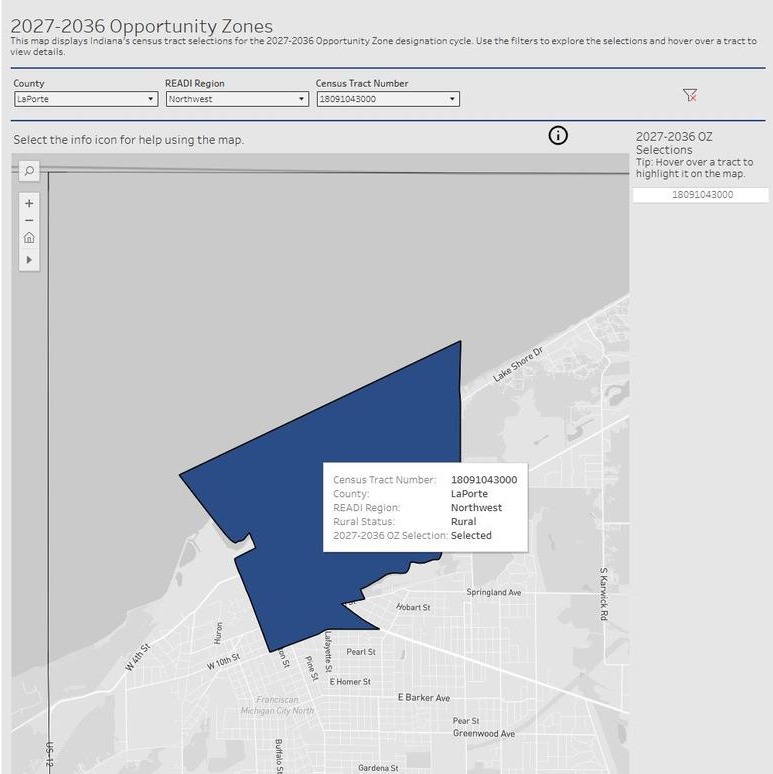
Sources: IRC §1400Z-2 as amended by One Big Beautiful Bill Act of 2025 (permanent OZ 2.0 program, effective Jan 1, 2027). Indiana nominated its 2027–2036 OZ tracts on Sept 25, 2026, including Tract 430 (rural); designation is pending U.S. Treasury certification and will be confirmed before deal close.
Every OZ investor scales in units of $100K. The math below is calculated per unit; multiply by however many units match the investor's gain size.
| Gain Size | Units | Scenario A eligible? | Scenario B eligible? |
|---|---|---|---|
| $500,000 | 5 | Pref only (needs 20+ for a home) | Yes — 5 pref units |
| $1,000,000 | 10 | Pref only | Yes — 10 pref units |
| $2,000,000 | 20 | Yes — 1 whole home | Yes — 20 pref units |
| $5,000,000 | 50 | Yes — 2 homes + 10 pref | Yes — 50 pref units |
| $10,000,000 | 100 | Yes — 5 homes or mixed | Yes — 100 pref units |
Same tax benefit, very different asset profile. Investors can pick one or mix both.
| Year | A — Build & STR | B — Pref + Option | Event |
|---|---|---|---|
| 0 | ($100,000) | ($100,000) | Invest gain into QOF; deferral begins |
| 1 | $0 | $0 | Construction year — no distributions |
| 2 | $3,900 | $9,000 | A: STR opens · B: pref cash begins |
| 3 | $4,100 | $9,000 | Operations year |
| 4 | $4,400 | $9,000 | Operations year |
| 5 | ($16,800) | ($12,400) | Deferred cap gains tax paid ($21.4K per unit) |
| 6 | $4,900 | $9,000 | Operations year |
| 7 | $5,100 | $9,000 | Operations year |
| 8 | $5,400 | $9,000 | Operations year |
| 9 | $5,700 | $9,000 | Operations year |
| 10 | $128,100 | $122,800 | Exit — 100% appreciation tax-free |
| Total | $144,800 | $164,400 | Net gain per $100K unit |
Model assumes: LTCG rate of 23.8% (20% federal + 3.8% NIIT); Indiana Dunes Club sits in a designated Qualified Opportunity Zone; investor qualifies under IRC §1400Z-2 and invests within the 180-day window; QOF and QOZB structures satisfy the 90% and 70% asset tests. Scenario A: 3,500sf luxury home @ $650/sf finished value, 4% annual appreciation, 195K/yr Year 1 STR gross ramping 4%/yr, 32% expense ratio, $600K construction loan at 7% IO. Scenario B: 9% cash pref, lot option struck at $25K/unit against 4.5% annual lot appreciation. All figures are illustrative and require full legal, tax, and sponsor documentation before commitment.
You bring the capital gain. Indiana Dunes Club Development LLC coordinates the entity work, the tax filings, and the compliance calendar so your QOF is ready to receive your rollover well inside the 180-day window.
Under IRC §1400Z-2 and IRS Form 8996 instructions, the OZ tax benefits only flow through a Qualified Opportunity Fund — an entity classified as a corporation or partnership for federal tax purposes. An individual cannot roll their gain into their own name, and a single-member LLC will not qualify because the IRS treats it as a disregarded entity.
The standard structure is a two-tier stack: a QOF LLC (taxed as a partnership) that owns membership units in a QOZB LLC (the project company where Indiana Dunes Club sits). The QOF self-certifies with the IRS by filing Form 8996 — no pre-approval, no allocation process.
Delaware or Indiana LLC organized for the purpose of investing in qualified opportunity zone property — the exact language the IRS requires in the operating agreement.
Indiana Dunes Club provides the template operating agreement pre-cleared by our tax counsel.
Add a second member — spouse, family trust, or a nominal 1% Indiana Dunes Club affiliate — so the LLC is a partnership for federal tax purposes. A single-member LLC will not qualify.
Indiana Dunes Club can serve as the 1% co-member at no cost to the investor.
Project-level LLC owned by the QOF that holds the Indiana Dunes Club parcels and improvements. This tier unlocks the 31-month working-capital safe harbor.
Indiana Dunes Club forms and manages the QOZB as part of the JV structure.
EIN, operating account, wire instructions. The investor wires the rolled gain into the QOF, which then capitalizes the QOZB — all inside the 180-day window.
Indiana Dunes Club coordinates with the investor's chosen bank; we can recommend one.
QOF files Form 8996 with its first partnership return. Investor files Form 8949 to elect deferral of the rolled gain and Form 8997 to report the QOF investment annually.
Indiana Dunes Club's tax counsel prepares the fund-side filings and provides investor Form 8949 / 8997 packets.
Semi-annual 90% asset test at the QOF, quarterly 70% tangible-property test at the QOZB, annual Form 8996, and K-1s issued to the investor each year.
Indiana Dunes Club runs the compliance calendar for the life of the fund.
Intro call, NDA, investor tax counsel intro, subscription docs delivered.
QOF and QOZB entities formed. Operating agreements executed. EIN issued.
QOF bank account opened. Wire instructions delivered. Investor wires rolled gain.
Form 8996 filed with QOF return. Investor files 8949 to elect deferral, 8997 to report holding.
Not legal or tax advice. Each investor should retain their own tax counsel to review the rollover and confirm state conformity. Indiana Dunes Club facilitates entity setup and files fund-level returns; investor-level filings are the investor's responsibility with counsel support from Indiana Dunes Club's tax firm.
How a $1M capital gain rolled into an Indiana Dunes Club QOF unit performs across the 10-year hold — deferral at Year 5, cost-segregation shelter across operations, and the 100% federal exclusion at Year 10.
The Year-5 tax is on the original §1400Z-2(a) deferred capital gain — cost-segregation depreciation from the property cannot offset it. Depreciation shelters property NOI (and other passive income; ordinary income if the STR meets the 7-day average-stay test with material participation).
OBBBA made 100% bonus depreciation permanent for property placed in service after 1/19/2025. The $245K accelerated deduction in Yr 3 far exceeds first-year NOI, generating $192K of excess deduction available to shelter other income (subject to passive-activity rules).
Exit-year note. Under §1400Z-2(c) the QOF investor elects a basis step-up to fair market value on the 10-year sale. The full $1M project gain — including gain attributable to prior depreciation — is 100% federally excluded. Depreciation recapture is forgiven to the extent the 10-year exclusion applies.
Illustrative example. Not tax advice. Investors should consult a qualified tax advisor. Federal only; state tax treatment varies.
Prospective investors and their counsel frequently ask whether Indiana Dunes Club must “double its cost basis” or change the use of the property to qualify for Opportunity Zone treatment. The short answer is no.
Indiana Dunes Club qualifies under the original-use test because it is ground-up construction of new buildings that have never before been placed in service in the Opportunity Zone. There is no requirement to double the basis of any existing structure and no requirement to change the use of the property.
Every tangible asset held by a QOZB must satisfy one of the tests below to be counted as Qualified Opportunity Zone Business Property. These are alternative paths, not stacked requirements.
Property is first placed in service in the OZ by the QOF or QOZB. The IRS treats newly constructed buildings and construction-in-progress purchased before the certificate of occupancy as original-use property.
Applies when acquiring an existing building. Investor must add improvements equal to the building’s adjusted basis within 30 months (50% for rural QROFs post-7/4/2025). Land value is excluded from the doubling calculation.
A building vacant 1–3 years (depending on timing relative to the tract’s OZ designation) or a designated brownfield site qualifies as original-use with no substantial improvement required.
Land is treated differently than buildings under the OZ regulations — the source of most confusion around the basis-doubling rule.
The OBBBA-introduced 50% substantial-improvement threshold for rural QROFs (effective for property placed in service after 7/4/2025) is a benefit that lowers the Path 2 hurdle from 100% to 50% of building basis. But it only matters if Indiana Dunes Club ever needs Path 2 — i.e., if a future phase includes acquiring and renovating an existing structure on an adjacent parcel.
For the primary ground-up development, Indiana Dunes Club is on Path 1 (original use) and the 50% threshold is not a binding constraint. It remains a valuable optionality reserve for future acquired-structure phases.
Indiana Dunes Club qualifies as QOZBP because the buildings we construct are new to the Opportunity Zone — the original-use test. This is the standard qualification path for ground-up OZ development and does not require doubling the basis of any existing structure or changing the use of the land. Investors’ tax counsel should review the Path 1 election in the executable QOF and QOZB documents at term-sheet stage.
Sources: IRC §1400Z-2(d)(2)(D); Treas. Reg. §1.1400Z2(d)-2; IRS Opportunity Zones FAQ A47–A49; Rev. Rul. 2018-29. Briefing document; not legal or tax advice. Consult qualified counsel.
The waiting was the work.
The moment is now.
The full financial model — four exit scenarios, live sensitivity, OZ waterfall — is one click away. Drag any assumption. See the deal rebuild instantly.
Open the Solo Investor ModelPlanning tool. Not offering material.
Serious about a ticket? Request the full offering package.
Request Investor Access →Accredited investors only. Reg D 506(c). Offering package delivered under NDA.
Selected reporting on the people, places and development stories of the southern Lake Michigan region. Read the supplied articles as PDFs.
Regional adaptive-reuse reporting, including NWI Development Group’s conversion of Hammond’s Calumet Bank building into The Banc.
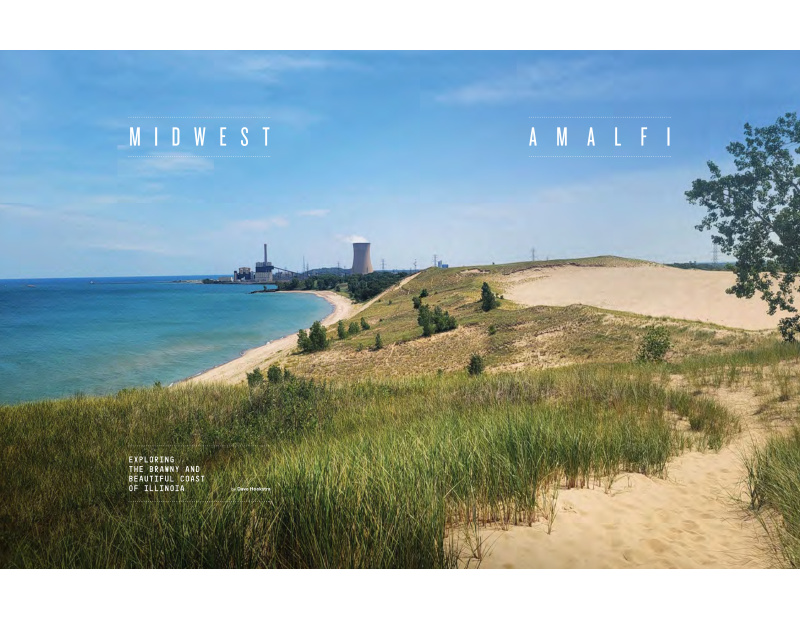
A magazine feature exploring the region’s industrial heritage, lakefront landscapes and communities along the southern shore.
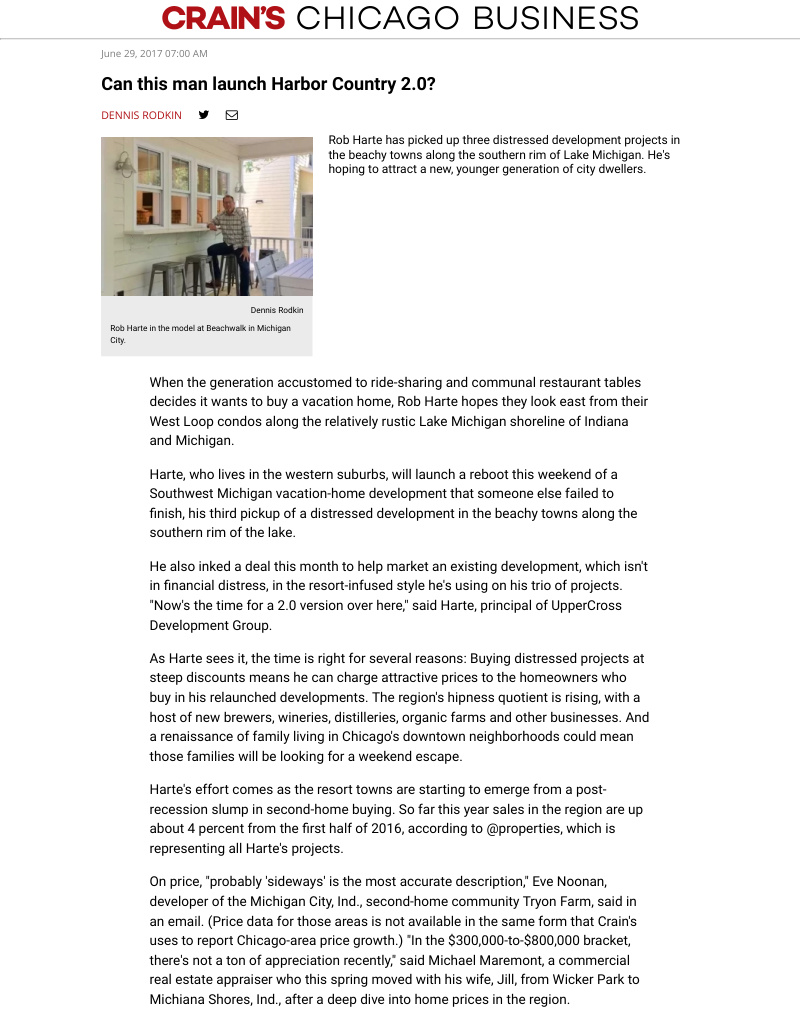
Dennis Rodkin’s profile of Rob Harte and his approach to vacation-home development along southern Lake Michigan.
Historical reporting reflects its publication date, not current project terms or entitlements. Original publisher content and credits are retained. PDFs open in a new tab; use your device’s PDF viewer to save a copy.